

Ground Calcium Carbonate Plant
What is GCC(ground calcium carbonate)
Ground calcium carbonate – GCC, which is also known as heavy calcium carbonate, is the major form of calcium carbonate powder product. It is produced by physical production method. It is made by mechanically grinding materials rich in CaCO3, such as calcite, marble, and seashells. Calcium carbonate is widely used as an additive across many industries, serving as a major inorganic filler in rubber, plastics, papermaking, coatings, inks, daily chemicals, and construction. Ground calcium carbonate (GCC) accounts for more than 2/3 of the calcium carbonate market.
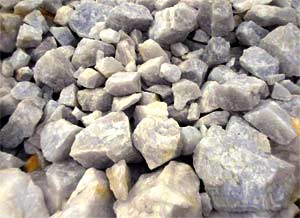 Calcite Mineral
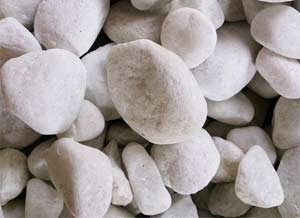 Marble Mineral
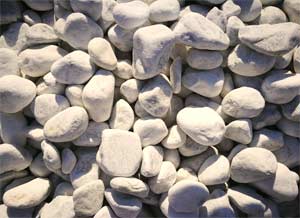 Limestone Mineral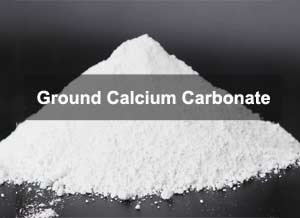
- Purity: The CaCO₃ content typically requiring ≥95%. The fewer impurities (such as SiO₂ and Fe₂O₃), the stronger the whiteness and stability of the finished product.
- Hardness: Moderate hardness (Mohs hardness 3–4) makes it easier to crush, while excessively hard ore will increase equipment wear.
Ground Calcium Carbonate Plant Solutions by Grinding Equipment
AGICO provides one-stop solutions for ground calcium carbonate production plant (GCC Plants) and other lime processing plants, offering tailored professional guidance and technical exchanges based on specific project requirements. We have rich experience in delivering efficient and timely services throughout pre-sales, in-process, and after-sales stages. AGICO has helped over 100 customers in smooth and effective implementation of ground calcium carbonate production line projects.
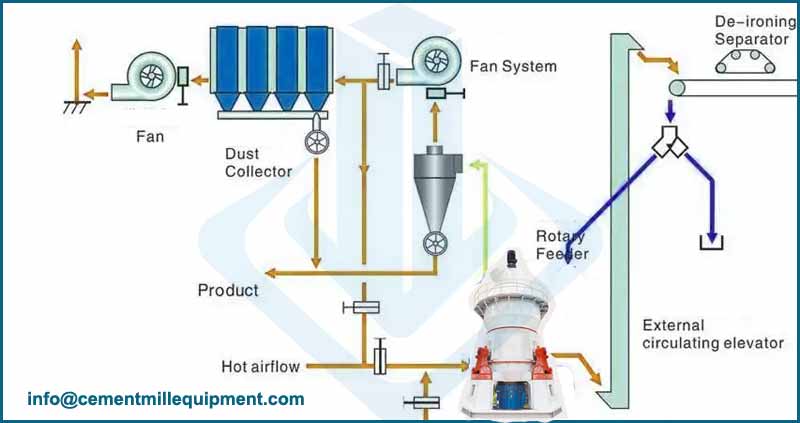 GCC Production Process - Vertical Roller Mill
AGICO has been deeply involved in the GCC and PCC production technology for over 10 years. We own a mature technical team and have extensive EPC (Engineering, Procurement, and Construction) experience in the manufacturing and construction of GCC production lines and precipitated calcium carbonate plant (PCC). AGICO offers 3 GCC production lines classified by grinding mill equipment:
GCC Production Line -Vertical Roller Mill
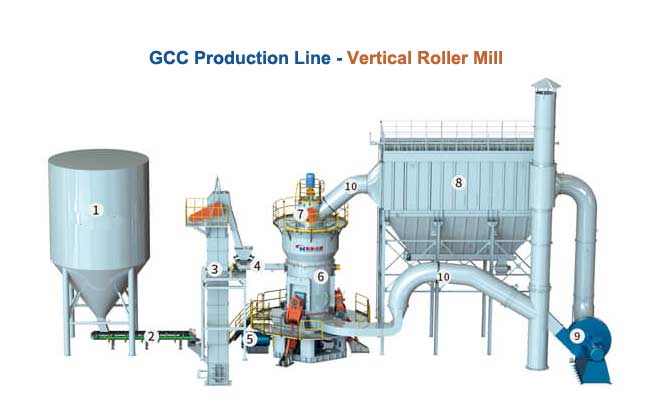
Complete Production Line (Semi-Open Circuit System)
- Raw Material Silo
- Belt Feeder
- Bucket Elevator
- Screw Feeder
- Drive Motor
- Main Unit (Main Mill)
- Classifier
- Pulse Collector (Pulse Jet Collector)
- Fan
- Piping System
GCC Production Line - Large-Scale Raymond Mill
Particle Size:38-180μm Capacity: 1-90t/h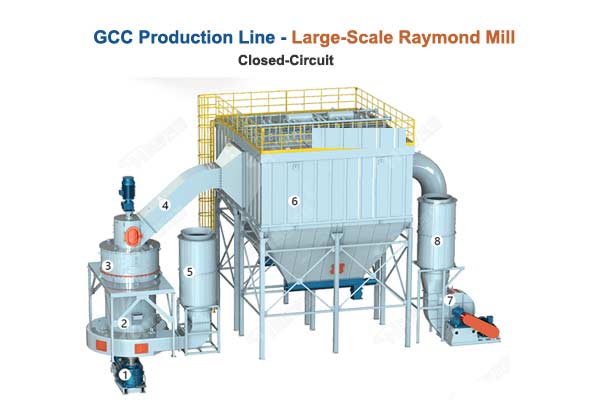
Closed-Circuit System
- Transmission Device
- Classifier
- Cyclone Collector
- Blower
- Main Mill
- Piping System
- Pulse Dust Collector
- Induced Draft Fan
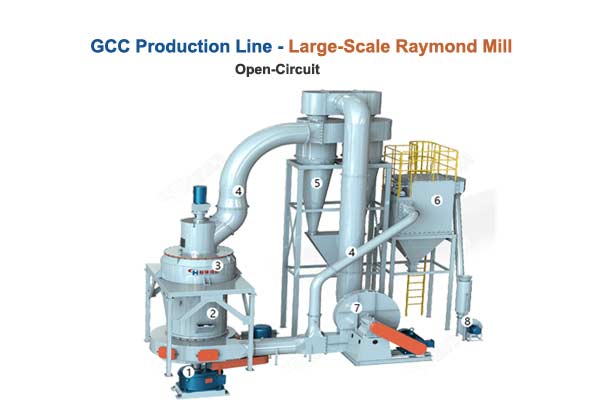
Open-Circuit System
- Transmission Device
- Main Mill
- Classifier
- Piping System
- Air Inlet Silencer
- Pulse Dust Collector
- Fan
- Exhaust Silencer
GCC Production Line - Ultra-fine Ring Roller Mill
Particle Size:5-38μm Capacity: 1-11t/h
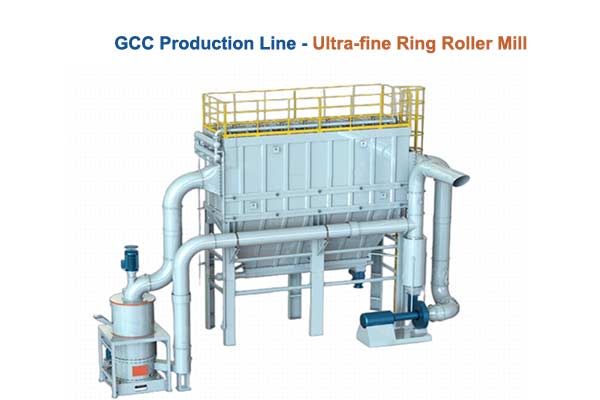
GCC Production Line - Ultra-fine Vertical Roller Mill
Particle Size: 3-22um Capacity:1-50t/h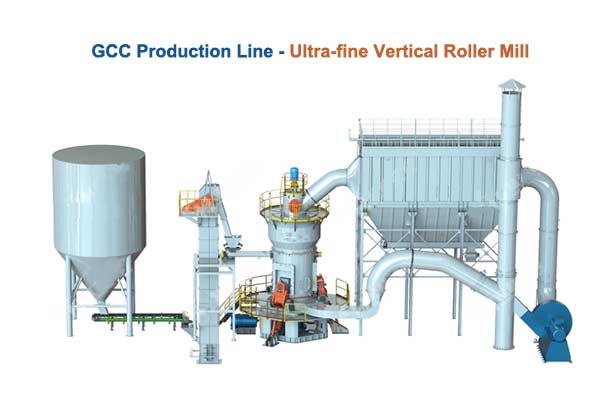
- Raw Material Silo
- Belt Feeder
- Bucket Elevator
- Screw Conveyor Feeder
- Drive Motor
- Main Unit (Main Mill)
- Ultrafine Classifier
- Pulse Collector (Pulse Jet Collector)
- Fan
- Piping System
Contact us Now if You Need the Following Services
Technical Exchange, Solution Customization, Equipment Manufacturing, Installation and Commissioning
Operation Guidance, Technical Support, Spare Parts Supply, Operation Trusteeship.
Ground Calcium Carbonate Production Process
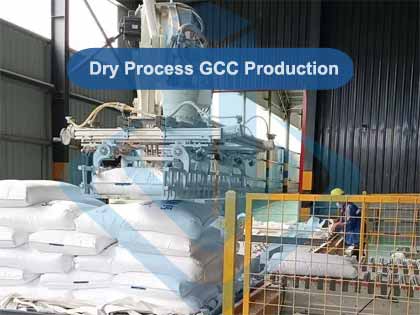
The raw materials for ground calcium carbonate are natural calcite, marble, and other raw materials, it is produced by simple steps of crushing, grinding, classification and screening process. The raw material purity and quanlity affects the power comsumption directly, so are grinding and grading technology. Based on the production method, it can be divided into: dry process and wet process. AGICO supplies dry process GCC production line solutions to customers, the step by step production process are as follows:
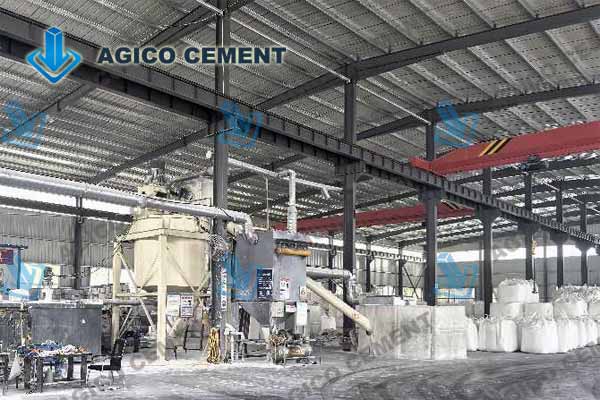
- Raw Material Crushing: Large pieces of calcite or marble need to be crushed first. The particle size entering the milling equipment should be less than 2 cm. For ultrafine powder, the particle size should be controlled under 1 cm.
- Grinding by Mills: The crushed raw material is evenly fed into the milling machine, where it is pulverized under the force of the grinding rollers.
- Classification for Screening: The pulverized material is blown by airflow into a classifier. Material meeting the required fineness passes smoothly, while unqualified material continues to fall back for further grinding. For ultrafine powder above 1500 mesh, it is recommended to enter a secondary classification system for further screening.
- Powder Collection: The qualified material enters a pulse dust collector or cyclone collector to achieve material-air separation. The collected GCC powder is sent to the next process via a discharge valve. Most of the airflow participates in the next cycle, while excess airflow is cleaned by the pulse dust collector and discharged into the atmosphere.
- Conveying for Storage: The discharge valve below the cyclone/pulse collector allows for direct loading onto a bulk loading machine for transport to the destination, or it can be conveyed to the finished product warehouse for storage.
Why use the dry process method?
The dry process GCC production method is currently the most widely used because of its simple production steps, low power consumption, and high-grade GCC powder product.
Crushing and Grinding: After washing and screening, the raw materials are fed into a jaw crusher for coarse crushing, then into a hammer crusher for medium crushing, and finally into a vertical mill or Raymond mill for fine grinding.
High Grade Powder: Modern dry-process production lines are typically equipped with high-efficiency classifiers that can adjust product fineness to meet customer needs, generally producing products of 400-2500 mesh (d97=45-5um).
Large Capacity: In a typical dry process production line, the main motor power of the vertical mill can reach 630kW, and the system output is approximately 10-15t/h (400 mesh product).
Advantages of GCC Production Line from AGICO
-
High Crushing Ratio And High Energy Utilization
Processes micro-powders with a D97 ≤ 10 μm in a single operation, with approximately 40% of the powder being –3 μm fine powder, resulting in a large specific surface area. It combines the high efficiency and low energy consumption of a high-speed impact pulverizer with the fineness approaching that of an air jet mill. -
Forced Turbine Classification System
Produces uniform and fine GCC powder particle size, easily adjusting the finished product fineness between 5 μm and 38 μm. The ability to produce different fineness grades better meets market demands and enhances enterprise competitiveness. -
Pulse Dust Collection System
Our pulse dust collection system adopts pulse jet cleaning method, using compressed air to clean each filter bag individually. It prevents long-term powder accumulation and filter bag clogging. Dust collection efficiency reaches over 99.9%. -
Low Wear, Vibration Reduction
Our Grinding mill machines use rollers and grinding rings made of high-grade wear-resistant steel, which extends the service life. The main grinding machine base adopts an integral casting structure, which offers excellent vibration-damping performance.